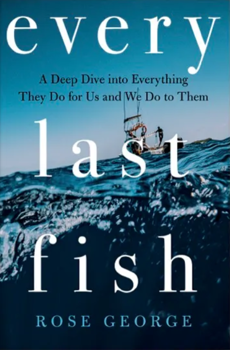
Every Last Fish: A Deep Dive Into Everything They Do for Us and We Do to Them is a nonfiction book by Rose George, published in 2025. George is a British author and journalist who has previously written books on the global shipping industry and refugees, as well as critically acclaimed books on little-covered topics such as blood and sanitation. The first chapter focuses on the decline in global fish stocks but also touches on fish welfare. We learn that 90 per cent of the world’s fish stocks are either over-exploited, fully exploited or depleted. A major cause of this is that global fishing effort increased ninefold between 1970 and 2008 due to advances in the efficiency of fish-catching technology. Like Callum Robers in The Unnatural History of the Sea, George says that we are only content with so little now because we have forgotten how plentiful the sea once was. Reviewing 120-year-old fisheries statistics to illustrate her point, George calls modern fisheries “an illusion of plenty.” Today, 80 per cent of UK and 90 per cent of US seafood is imported, meaning people in rich countries are simply not aware that the seas around them cannot supply anywhere close to the amount of fish that they eat. George states that there are no gaps on fish counters or in shops because the gaps are in the ocean.
George is adept at looking through the euphemistic language employed by the commercial fishing industry to hide the reality of what is happening to the world’s fish. Technical terms such as yield and stocks are used when discussing fish, but not with any other species used for human consumption. Similarly, fish are measured in tonnes, but this is not done with farmed birds or mammals, which are instead counted as single units. She uses the term fishes against grammatical convention, “because the singular plural noun fish makes it easier to dismiss trillions of creatures as a mass.”
While the first chapter was an overview of the state of the world’s fisheries, the second is very different, being a case study of struggling fishermen in Filey, North Yorkshire. George goes out with the fishermen and reports from a first-person perspective on the fishing trip, explaining how they now catch mostly lobsters and crabs as severely diminished stocks mean that catching finfish is economically unviable. The number of fishermen in Filey can today be counted in single figures, and some of them only do it as a second job, whereas it was once the town’s main source of employment.

A few chapters in, it soon becomes clear that this is a wide-ranging book which will jump from topic to topic with each chapter. Furthermore, what is under discussion at the start of one chapter may have changed to a different, but connected, topic by the end of the chapter. In the third chapter, for example, George talks to representatives of the National Association of Fish Fryers, where we learn that there is no official or legal definition of fresh when it comes to fish (meaning the fish being purchases as fresh can be caught a lot longer ago than many consumers may have thought) and that US-imported Pacific salmon and rockfish are slowly replacing cod and haddock in British fish and chip shops. This then turns to an examination of the history of selling fish and an explanation that fish fingers (which were almost called cod pieces) became so popular as they were freezable and sold as being bone, smell and fuss-free. The same is true of the chapter A Tin Can Navy, which begins by covering migrants being rescued by fishing boats and then switches to trawlers being used in wars. These changes in topic are mostly welcome and mean that a wider range of issues can be covered. However, they do not always work. The chapter on African waters being overfished (mostly for species which are then sent to Western consumers) has a very strange and disorientating aside into fish skin being used in skin grafts and cosmetic operations on humans and pets, which includes a short discussion about her own pet cat. It can sometimes seem as if George has an interesting fact or discussion but no obvious chapter to put it in, so it therefore gets shoehorned awkwardly into any chapter (the strange discussion of Trimethylaminuria (fish odour syndrome) is a case in point.
George provides a wide array of interesting facts. We learn that global bycatch amounts to 720,000 seabirds, 300,000 whales and dolphins and 1.1 million tons of sharks and rays, that “a quarter of all militarised conflicts between democracies have been over fisheries” and 25 million crab and lobster pots are lost at sea each year. George is skilled at weaving facts and statistics into the narrative, and it never feels like the reader is being subjected to a dry, technical analysis, even in the parts of the book which are somewhat statistic-heavy.
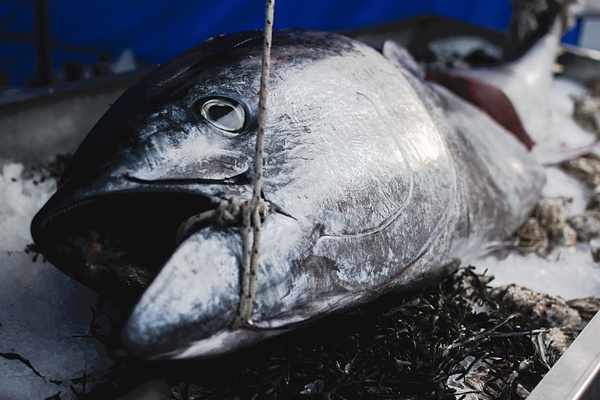
One misstep happens early in the book when George states the often-repeated statistic that a tuna can be worth millions of dollars. The reality is that there is a Japanese custom where the first tuna of the year is auctioned for an over-inflated price due to the prestige purchasing the fish bestows on very rich Japanese business owners (such puchases also attract free publicity and set a high price for tuna for the rest of the year). But George makes it seem as if any tuna can potentially be worth this much. Another point that rankles is George criticising British fishermen for now being able to catch 39 tons of tuna following the species’ return to British waters, while completely failing to mention that the seven EU countries which have had a bluefin tuna quota have been consistently catching the species in European waters for decades. Spain, for example, had a quota to catch 6,700 tons of bluefin in 2025, dwarfing the tiny British quota.
Despite this, George is always sure to present both sides of an argument. This is aided by George taking something of an ethnographic approach to some of the chapters, not just meeting fishermen but going out to sea with them to see how they work, which leads to her battling the elements and seasickness. George is always fair and puts forward both sides of an argument. She listens to the fishermen she is with tell her that trawling doesn’t damage the seabed, or at least not as much as is claimed, and then tells the reader the truth about how damaging trawling is to the seabed and wider marine environment.
A major strength of Every Last Fish is the new areas it covers. Ghost gear – nets and pots which are lost from commercial vessels but still keep on catching fish – is the topic of one chapter, while another looks at the dangers and risks of being a fish warden who observes catches on commercial vessels. With unexplained deaths, evidence of bribes and corruption and one observer being found dead with blunt force trauma to the head, George highlights a little-known part of the world’s commercial fishing industry. The Chaper A Very Slavery Job tells the heartbreaking story of Ghanaian fishermen who were effectively made slaves on a UK-registered fishing boat. While this was briefly reported in the UK media at the time, which has certainly been underreported in the British media.
There is barely any mention of angling in this book, but that is not to say that anglers would not find it interesting. George is aen very engaging writer, and while this reviewer found some of the asides and topic changes at times jarring, another reader may well find them interesting and entertaining. This is not a systematic assessment of the world’s fisheries, but a personal look at a broad range of topics related to fish, fishing and the marine environment. Every Last Fish is a hugely enjoyable, entertaining and informative book which is highly recommended.